
Options Trading Journal vs Spreadsheet for Multi-Leg Strategies
Spreadsheets survive until the third roll. A journal next to daily P&L keeps multi-leg structures, notes, and the rollforward on one definition of the book.
By CoveredLoop
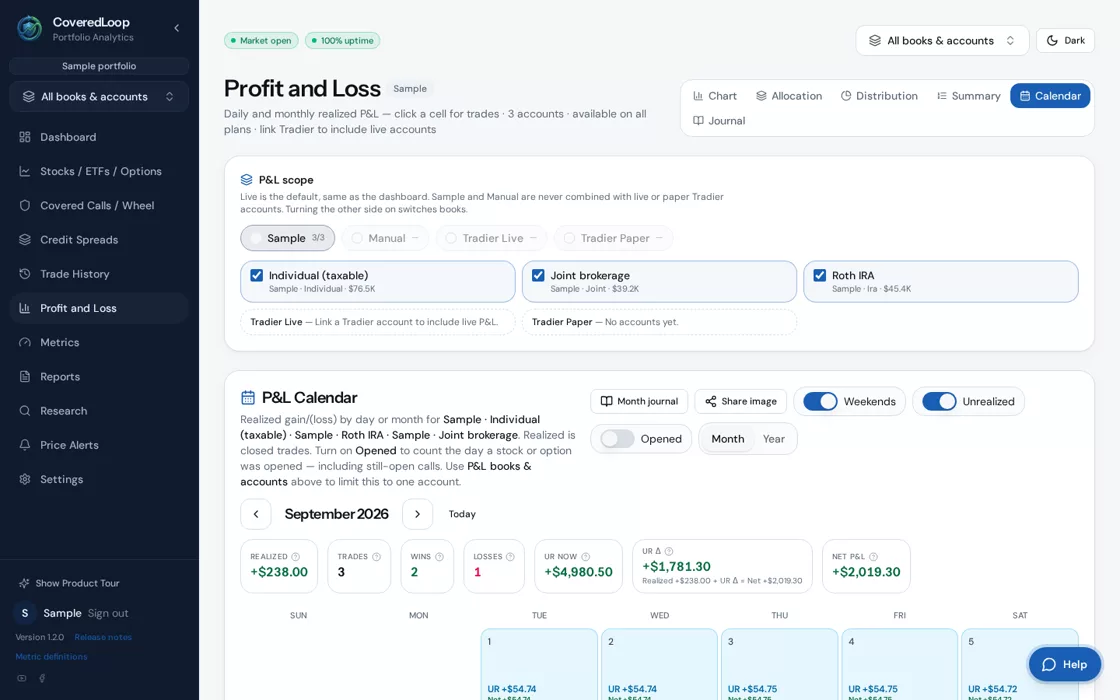
A spreadsheet can track a covered-call lot. It rarely survives the third roll, the first assignment, and the week you forget to mark the short call. A journal in another app drifts from the blotter in a week. CoveredLoop keeps the journal inside Profit and Loss so a note about a roll sits on the day whose realized and unrealized already include that structure.
This is a process note, not a claim that journaling makes you profitable. A well-tagged losing day is still a losing day. See the risk disclosures.
What breaks in the sheet
Multi-leg strategies fail in spreadsheets the same way: legs lose their pairing, closed premium is deleted when a roll happens, assignment creates a stock row that never finds the option row, and unrealized is a formula nobody trusts. Iron condors are four columns that get copied wrong. Wheels are three chapters in three tabs.
CoveredLoop is opinionated. Covered calls and wheels are structure cards. Credit spreads keep credit, max risk, ROC, and duration together. Trade history can take a note in one click. The calendar is the daily cut of the same P&L as the dashboard tiles, not a parallel workbook.
What to write down
Useful notes are operational: plan vs execution, session tag, size, why you rolled, why you did not. “Felt good” does not help next month. The journal is not a public track record and we do not publish your notes. First name and last initial only appear if you later send a public testimonial and an admin approves it — that is a different feature.
Rollforward instead of reconciling cash twice
The account-balance rollforward is opening equity, transfers, dividends and interest, margin interest, fees, realized, unrealized for the period, and ending equity, with a column per account. Sample and Manual use the cash you enter. Live Tradier pulls activity from the broker log. A journal note about a dividend day should sit next to that same cash line.
If calendar unrealized looks like a phantom low, it is a holdings definition bug, not a prompt to fork another sheet. Current unrealized is supposed to follow live broker holdings for the selected accounts.
Metrics when the diary is not enough
Win percentage, profit factor, expectancy, Sharpe, and the rest recalculate for the accounts you select. Metrics without a journal are a scoreboard. A journal without metrics is a diary. Both belong behind one account filter.
Spreadsheet export still exists
When you need a paper trail outside the app, export Excel or CSV. That is an exit ramp, not the system of record. Import exists for broker files that do not share one column layout — CoveredLoop maps fields, pairs opens and closes, and keeps lots apart, including multi-leg credits.
Start on Sample, click a day, add a note. That is the whole test. Related: wheel journaling, Tradier vs manual, What We Offer.